Showing posts with label digital art. Show all posts

Monday, November 26, 2012

Massage the Message

Spielmann used the Vasulkas and Paik as the examples of the two different paths of how to understand video and the electronic medium. Basically, the Vasulkas’ experimental video works were working on investigating the new electronic medium’s internal world, its transformative and “massaging” capabilities. In this path, video artists explored the medium’s manipulative potentials and tried to prove the medium’s extensibility itself. Just like how Hill used video graphics to build a new electronic vocabulary. They viewed video medium independently and demonstrated the interrelation of machines and the video medium. By exploring the structure of interrelation of video medium, those artists experimented the generation of electronic pictoriaility, and its flexibility, instability, and exchangeability. In experiencing the manipulated delay and feedback that happen exclusively in video medium, those artists were trying to achieve a conceptual understanding of the time and movement in electronic media. They explored and discovered the structure specific to video medium, and demonstrated the notion of coherence through construction as well as deconstruction of the audiovisual signal process in generating an electronic pictoriality.

However, the other path, as the work from Nam June Paik, was working more on the possible effect of multiplication on the video-television interaction and its multimedia spectacle performance. Paik had a very different attitude toward how art understand the relationship between video and its implications for conceptual creation. His major difference from the Vasulkas started from their difference views on how to differentiate video and television. Like how Paik did in his work McLuhan Caged, he was doing something more than just manipulating a fluid digital pictoriality inside a computer screen, he inserted video and other media art into his television. Television as a preprogrammed medium of transmission was not in the exploration of the first path of experimental video artists like the Vasulkas. However, Paik’s remediation of the television program as a medium did take a great part in his art approach, which was demonstrating the notion of “message as the massage”, and applied it into his television’s existing program structure.

About the idea of massage the message, the Vasulkas concentrated on the video’s structure and the fundamental matrix inside the video medium. Like what he did with the work Art of Memory, he explored the possibility to massage the shape, color, duration, implications of historical records in his video, and then presented the medium’s capability in massaging or distorting the conceptual content of imagery, in deconstructing the older media’s social functions as well as establishing a new image culture. Well, Paik’s approach to distort a television image by giving the media a magnet massage truly responded to McLuhan’s media theory. Not only the message from the media is new, but also the media’s massage on the message itself. Paik’s art approach was focused on the interference and distorting the electronic pictoriality with the regard to the basic electronic signal. The massage and manipulation and explanation of media as message itself was represented in his artwork. The electronic pictoriality, as the major art investigating point for the Vasulkas, was nothing more than a signal process to Paik, and he was using new machines to insert the electronic pictoriality into his television for displaying a more complex and complicated electronically transformation, which demonstrated his distinguished understanding toward the aesthetical concepts about the specifics of video as a new medium. 

Hill's Electronic Vocabulary


Gary Hill uses video as a way to understand or take apart or deconstruct language. He then applies his knowledge of language to “create a link between images and electronics”. How does he accomplish this? How do his videos change or potentially change how we view or understand language? 

Gary Hill used video as a way to show how a linguistic system can be translated into the audiovisual displays in digital formats. He began his experiments with semiotics and explored with linguistic insertions, sounds, syllables, and spoken words in his videos, trying to discover new contexts of meanings above the linguistic level. In the aim of creating a link between images and electronics, Hill exemplified his concept in his early experiment, Electronic Linguistics (1978). He translated electronic sound signals into a “language of imagery”, and by recording the digital signals he represented and visualized his transcription process at the same time. In the experiment, he made his digital “monadic” structure grew into something intensive in the screen, demonstrating the energy and productivity of one single basic unit that make happen to any bigger phrases, which was the working system in both cyber world and linguistics world.

His work Primary (1978) inspired me mostly. When seeing the speaking mouths flashing with corresponding colors and spoken letters, I found myself very unconscious about the speaking worlds and the colors, and especially the relationship between the two parts. I was questioning the very first invention of the word “red”, “blue”, and “green”. They can mean something different if the inventor put another meaning on that certain word. The language is a system of relationships between visualized characters and their decided meanings. But when we watch something in a fast flow and the visual part is very dominant, we may ignore the sound and the meaning behind the spoken language. I’m wondering if the color on screen was green while the spoken word was red, will I feel strange or will I ever notice that? The relationship between words and their meanings are so fragile because people manipulated them, and they can easily change by the differences in cultures and times. While people’s understanding and recognition toward certain things or knowledge are based on linguistic definition and language system, just as we would respond to the real color of red when we hear the word “red”, but what if the really color of blood was not called as red but as green? How would that change people’s knowledge system? Or what should be the right or the correct relationship between words and meanings? Or why does it matter to us? 

Video Art and Forming Memories


In Woody Vasulkas' of Art of Memory, the artist integrated the documentary film and photography into flows of digital manipulated images. Black-and-white newsreel footages of cavalry and flaming buildings were processed into moving, multi-screen polyhedrons; the sky behind the figure suddenly crawls with geometric "rain". Then comes the voice of an important historical feature, on seeing the first explosion of the atomic bomb. Vasulka transformed the historical imagery and audio into new visual displays.

First of all, the obvious theme for this video is a critique on the use of historical recording imagery technology, photography and film. By transforming the footages and images of wars into fluid digital movement and ambiguous shapes, the artist concerned about the military-industrial use of such technology. He was questioning on the present and the preservative aspects of history and our memory about that. His point was to deconstruct the relationship between our memories about the history with those “historical” black and white events footages. By transferring the filmic records into other media and translated them into the state of an electronic pictoriality, he challenged the priority in human notions and entered into the private space of historical documents.

Secondly, the major theme for Vasulka’s work is to investigate the historical distance of the media used and point to the storage function of historical documentary imagery and sound. By transforming old records of images and sound into energetic and fluid electronic movements, he freed or activated those dead visual/audiovisual materials, and then translated them back from being a container of human memory into remembered history. He changed the critical distance in the display of imagery as memory. By making the war footages into waveforms surfaces in the new electronic pictoriality, Vasulka used his computer- generated forms proved how memory distorted the shape of events, and how permeable was the media imagery as a container of supposed truth influenced our understandings. By this, he demonstrated the self-reflexivity of video technology as a new medium. And then brought new notions to the aesthetic content in understanding the distance between the two levels of display, resulting in exploring the construction of our memory based on a picture world and the way to view our imagery cultural. 

Saturday, November 24, 2012

Inputs and Outputs

After talking about Guerilla Television and Artistic Video, Spielmann introduced the third group of video art, the Experimental Video in the second chapter of her book, Video: A Reflexive Medium

In explaining the concept of Experimental Video, the author said, “it understands the new medium dialogically in the interrelation of technology and aesthetics and undertakes experiments in images technology as a possibility of reaching a new language of imagery by talking issue with the form of the medium.” In exploring the dialogs between aesthetical expression and developed technology, the experimental video artists, or say image technicians, focused on inventing a new language to translate their artistic ideas into images. The experiments they’re doing were discovering and deconstructing the relationship between images and messages, and more importantly, the ways of generating ideas by imagery. They experimented the various possibilities to connect thoughts with visual/audiovisual imagery by investigating the forms of video medium. The “new” approaches here are brought by their avant-garde ideas to speak a new digital language in an image world. The new language is constructed differently from the traditional preceding camera-obscura perspective. The conventional methods of producing a visual/audiovisual expression is replaced and expanded through the experimental video medium. The new art approaches are trying to innovate a genuinely electronic vocabulary based on their new discoveries of technical devises to generate and output images.

A video synthesizer generates signals to produce imagery. As a more complex device than audio synthesizer, the video synthesizer covers a much larger amount of digital signals in multiply dimensions. A video synthesizer is like the paint and palette of a video artist. It translates the ideas and concepts into different signals and then generates images and transformations, and makes it possible to achieve numerous effects and distortions by controlling the waveforms. The additive synthesis is the most common technique for generating waveforms. It mixes the output waveforms of oscillators to generate a new waveform that is the sum of their combined outputs. It makes it possible for artists to duplicate any natural waveform by summing sine waves of different frequency and produce unexpected output imagery. The Scan Processor Studies by Woody Vasulka and Brian O’Reilly is a good example for video synthesizer and its product. The No.18 might be the coolest video I’ve ever seen. In the nonstop powerful digital flows, the forever transforming imagery suggests the audience the uncertainty of electronic aesthetics in a very beautiful way. In the vague forms of mountains, oceans, deserts, especially with a screaming woman’s face inside, those mysterious and energetic visuals combined with immortal electronic sound and beats demonstrated the infinite imagination and artistic expressions generated by the imagery and audiovisual world produced by a synthesizer.


Then, the development of image producing devices leads to the two different ways that a video can be generated.
One way is to generate signals by a video synthesizer and an audio synthesizer based on modular processors. Like the video synthesizer built by Eric Siegel, it can manipulate the size, form, and color of the waveforms and then generate a video. The modular designed synthesizer allows parallel and simultaneous prepossessing of high frequency signals.
The other way of creating video changed the control of processing steps, allowing artists to control several different video sources in a sequence simultaneously and separately. The sequencer can depict the structure of an electronic image in the waveform; and the programmer can monitor the arrays from the video sequence digitally and it can store operation sequences in its memory and activate them at any chosen moment. Both of these developments in controlling the processing steps expanded the possibility to visualize the electronic signals and manipulate the information in real-time and deviate the signal from the usual linear sequence. Analog scan processor can present the scan lines in waveforms, and then enable artists to use this reflexive procession to visualize a video’s generic natural processes. Just like how it works in video feedbacks, this way of generating video imagery allows the video to present the circulation of the audio and video signals without external inputs. The method is workable in both externally and internally generated signal processes. In this way, the concept of “images” in video art is replaced by the concept of “image field”, or  “pictoriality”, because of the breakdown of the structure incoherent in imagery and the layers of imagery become so multiply that it is no longer to depend on a bounded surface of imagery.

Sunday, November 18, 2012

Image Technician


Spielmann describes the video artist as an “image technician”. 
How or is the content/concept of these videos connected to their process of their making? 

The image technicians are the group of video artists who explore their experiment videos concentrating on their conceptual, structural, and technical standpoint including the equipment they're using. I believe many great video artists can be grouped together under this definition. However, I doubt the point that every video artist is an image technician or should they. 
My reason is that the video artist as an image technician experiment their use of video media and the creation of digital signal are a big part of their art content; but it is not necessary for every video artist. There's no doubt that image technicians made great significance in the development of video history. A wide variety of electronic instruments  have been constructed by those engineers and visual artists over the past years. Their discoveries on operating television technologies created new and dynamic forms of digital imagery. From layers mixing, video feedback, colourisers, chroma key, analogue effects are invented to modify the visual world to better convey the ideas of video artists. It is true that those image technicians did great efforts in artistic and imaginative explorations to expand the visual dimension and the horizon of the human imagination. Just as the points from El Arte Del Video Video Synthesis, with the development of techniques, modern TV images do not need to be generated from a camera. It is a fundamental changing point for video art, meaning the coming of new tools, new effects, and new languages to break and transfer reality into art making. 
Video synthesis gives the visual artist the power to realise that which is subject to the creative faculties, allowing a freedom of expression and dynamism using form, shape, colour, texture and motion generated by electronic means. Then artists can change the appearance and behaviors of the imagery to work for their decided concepts. For those video artists working as image technicians, their technical capabilities fundamentally influenced their art content and then impacted dramatically on their art making processes.   

Saturday, November 17, 2012

Video Feedback

Video feedback is continual and processual series of digital images created by the electronic imagery itself. It is a process that starts and continues when a video camera is pointed at its playback on a video monitor. The image from the camera is delayed slightly in time as it travels through the extensive circuitry of the recording system and then is output to the video playback monitor. Video feedback is not invented; it is a digital phenomena as the form of a dynamic flow of imagery created by the digital world itself.

VanDerBeek gained great significance in his video feedback experiments. Good examples can be found in his work Poemfield NO.2, stared from 4:25. He's trying to create new graphic and new images by the corresponds between videos and movies. He explored the visual possibility of the mix of media, raising the question of what is the illusion? What is the reality? What is magic? He's testing the power of images created exclusively in the digital visual media. By creating a new combination of computer imagery and digital imagery, VanDerBeek expanded a new visual world and a new cultural environment. He explored the relationship between man and machines, and then investigated the video feedback as a new language form.

Also, in Euclidean Illusions, the video feedback started from 1:01. The beautiful image flows suggested the infinite spaces and times in the digital imagery. The unpredictable patterns grow inside the projected picture, creating an endless power box at the same time. The video feedback reminded viewers about the mysterious of digital creation, and its unpredictable power, and also the sense of uncontrollable. The infinite spaces brought up an infinite amount of energy to the media itself. Then let the audience to analyze the current relationship between human and the digital.
 

Tuesday, November 13, 2012

Image Field


Spielmann describes video as medium constituted as an image field. What does it mean?

Paul Sharits, Tony Conrad, and Hollis Frampton used video medium to investigate the structures of moving images right up to the limits of perceptible changes in movement. Instead of making art of still images, artists can expand the possibilities of artistic expression by exploring the visual/ audiovisual capability of video medium. The concept of image was replaced by the concept of "image field" because the video imagery was no longer just still, static, one layer pictures. 

In Paul Sharits' video work, T,O,U,C,H,I,N,G, (1969), the artist made this piece basically based on two different images. However, this 10 minutes video is very powerful to audience and never be boring. The energy of the video comes from the transition and movement between images and the special effects that can only produced by video medium. The image of this video is a image field, which including various layers, and the spaces, power, changes between those layers. Tony Conrad explored the visual effects exclusively happen in digital video imagery in his Flicker (1966). These magical and amazing patterns of lines, dots, white spaces can hardly be reproduced in other art visual medium creation. In this work, the visuals become an universe that can give birth to numerous new images. Just like an image field that can grow thousands of different plants. In Hollis Frampton's work, he used 7 minutes to film a single Lemon in dark without any sounds. The holly-like lemon showed up from dark and disappeared into dark again, just like a hollywood star. Frampton demonstrated the hidden power of the imagery in a video. The minus movements and most unnoticeable changes of the screened image made it so different from a picture. The various zones, different layers, and the multiple surfaces of the image expand all these works.

Monday, November 12, 2012

Feminist Video Art


How do the works of  Valie Export, Jill Scott and Frederike Pezold critique the mainstream media concepts of women? 
Or do they? 


The first generation of women video artists in Europe used the video medium to examine images of their own bodies from a decidedly feminism perspective. Export, Scoot and Pezold are famous for their artistic approaches to deconstruct normative poses of female bodies, which are supposed to express beauty and grace.
Honestly, Export's work Remote...Remote... (1973) was very disturbing, and I cannot look at the screen after suffering the imagery pains for 5 minutes. Valie Export conducted a psychological investigation, as well as a physical distortion of her body in this film performance. She tortuously cuts into her cuticles until blood drips into a bowl of milk on her lap. The film started from a picture of two young children. From the film statement, I found that the two children inside the picture were sexually abused by their parents. The film had some very close shots with the children's wild-open eyes. While the artist's eyes were always cold and unconcerned, even when she's hurting herself. The video challenged the views in an extreme way to show her cooly cutting her body with her indifferent attitude. That presented a very different female role from the traditional stereotype, which is soft, fragile, warmhearted, and sweet.
Frederike Pezold used female bodies as a new embodied sign language. By enlarging a certain part of the body, or putting different distorted parts together, she used women's psychical body as a sign, a language to express her thoughts. The body part no longer appears beautiful, grace, nor sexy in our mainstream media concepts of women bodies. The female body became a medium for Pezold.
In her work Inside Out (1978), Jill Scott created a basement outside on a pavement. She's staying inside the basement and can only look the world outside through the camera monitor, while people passing by can see her through the video camera. People on the street can actually be curious enough and go into the basement to see her doing. By this installation and experiment, Scott critique on the female images showed on the media monitors. People are seeing and understanding women by viewing the images on TV screens and took the manipulated roles as truth. And sometimes, housewives can also understand the world only by watching TV or computer monitor. But what actually inside the basement can only be known by entering that space. And the mice under the basement can be seen as the fears or daily stresses for females.

A Critique of Modern Art


Baldessari's video art work concerns video as a medium. "The live character, the directness and simultaneity of recording, and reproduction" of the medium function well in connect with audience, and that brings more meanings to the artistic video action and video performance.

In particular, Baldenssari always performing before the camera, and let the film record everything he does. Without any editing, cutting and refining to the footages, Baldenssari used his video action as an ironic critique of the genre of conceptual art and Fluxus art. 

In Baldenssari Sings Lewitt, (1972), he put arcane theoretical discourse and popular music together by singing Sol Lewitt's comments on conceptual art in selected popular melodies. This "art aria" functions as a meta-conceptual exercise to comment on the arrive of mass media in all communication formats. 
The critique of "an art-immanent illustrative typology of art" became more obvious in his work, Teaching a Plant the Alphabet, (1972). The uncut videotape of his live performance was so boring and dead to watch and that challenged the audience's view about the protected realm traditional concept of video art. He investigated the situation of those protected realms of art, and demonstrated the influence from pop cultural and mass media, which constructed the modern art in a large extant. However, Baldenssari also critiqued his own idea in his earlier work I Will Not Make Any More Boring Art (1971). In this really really boring video, the artist used the medium itself to address his give-up on pursuing the immanent nature of fine art in today's media world.

Sunday, November 11, 2012

Boundaries: establish and destroy


Vito Acconci investigated the space for presentation and real action through video recording and transmission onto screens in his video art work “Claim” and “Pryings”. When exploring the notion of space in video media and its exhibition, the artist played with an idea of boundaries.

When watching these two videos, I find myself physically uncomfortable with the content and it's really hard to finish them. 
In "Claim", Acconci was blindfolded and yelling aggressive words with a crowbar in hands. He's using his sayings and body movements to build a boundary between himself and the rest of his world. The performance was held inside a small cell under the gallery space, making the boundary between the live performance and the exhibition space was real and physical. The physical boundary can be the gallery floor or walking stairs. However, even after understood the fact that the performance was live and live-recorded and projected into the gallery space, the audience would not notice the physical boundary when they watching the monitor. Instead, the phycological boundary was established and became much stronger.
As we know, even though all the audience knew that they can go downstairs to interrupt the performance, no one ever did that. Maybe because the audience were afraid of the performer, or they felt it's strange to go out of the gallery space to watch an art. Anyway, the phycological boundary worked. I imagined myself watching this art piece personally in a gallery, and I would not go to the cell neither. Simply because I felt the performance was so real and it broke the boundary between performance and reality, therefore I saw clearly the boundary between normal (me and gallery) and abnormal (Acconci and the cell), and I rejected to go across such a boundary. 

Such phycological boundary also appeared when I watching "Pryings". I felt physically uncomfortable and no longer want to go further. In the video, Acconci was trying to open the woman's eyes by force. He wanted to go across the physical boundary in a human body. Keep your eyes open is a metaphor, which can mean let someone see and understand and accept. The woman resisted to open her eyes, even when her eyelids were opened the woman hided her iris. She was trying to stay inside her body boundary and rejected to accept the masculinity force.  Since eyes are very fragile parts in human bodies, audience would feel spontaneously uncomfortable and attacked by viewing the video. Therefore, the audience outside the space of live performance/action would easily feel the violation. The physical and physiological violation breaks down the boundary between performance and reality, and then makes the boundary of performed action and displayed action uncertain.


Saturday, November 10, 2012

Swimming in Your Age


Janice Tanaka's video Swimming in Air

I'm not sure whether men care about the fact of being older everyday or not, but apparently, women care. In fact, women's awareness about their age and social reflection can really affect their psychical bodies and psychologic world. 

From an innocent little girl to a mature adult, from a young girl to a sexy lady, women's roles and self-responses are changing all the time, within the changing process of their bodies. Self, career, marriage, children, family vs. business, this is a timeline as well as a struggle-line for every female. Especially to the females whom living in an Asian culture environment, the pressures they received from social definition, from men's "controlling" system, from traditional family responsibility are much higher than living in a Western culture. 
Janice Tanaka's video Swimming In Air is exploring such pressures brought by psychical aging and social definition. Being old and cannot been loved anymore are the ultimate nightmare for every woman. Besides, the desire to being yourself, to do whatever the heart wants always falling in conflicts with the social expectations or traditional women responsibilities. The sufferings of a self-expeacting ego consistently struggles inside a "nonfunctional" body can hardly be stopped in a woman's life. The very real possibility of becoming too old to realize a dream nor fulfill a desire is intimidating.  So the fears of being old is infinite in a women's everyday life. 
As females, we always unconsciously question ourselves "when does our awareness of youth begin. . . after it has passed?" in so many different ways and various occasions. However, how does the awareness ever change our experience or the way we act is something we might not do everyday. The answer to the question is hard to say, but we all know the answer reflects a true but very sad reality. 

Friday, November 2, 2012

Telling Facts and the Fact of Telling


Documentary films are intended to document some aspect of reality, primarily for the purposes of instruction or maintaining a historical record. Under this understanding, both "Magic for Beginners" and "Hard Fat" are very "factual" to me. 

Magic for Beginners examines the intimate relationship between human and media, or say people and television. Such close and dependent relationship between human being and media world is the topic brought great concerns in today's information generation. People become more comfortable with being friend with the characters in television, or even fall in love with them, result in the fact that people become afraid of the real world or talking to real people. Such kind of phenomena is very common and start to grow in this internet world. So, the artist's exploration on people's obsession on media and the following crazy fan culture is quite factual and informative.
When questioning people's need for such intimate connections with media (whether real or imaginary), the artist use the idea of mythology to capture such psychic connections. For example, when the narratives were talking about the personal story with a tv character, the portrait of the boy started to shake and became dizzy. With the transforming effects and background sounds, such imagery reminds me a lot about the illusion and the scenes in a horror movie. I think this artistic expression is very effective and works great for me. Since when I was a kid, it was very hard for me to distinguish the story in tv from the story in my dreams or in real life. The incredible impact of television, video games, and other interactive entertainment forms force people to relay more on this builded-up imaginary world, resulting in a growing need for such emotional release that only fantasy and fairytales in media can provide. The end of this video, different people from different ages, different places singing Titanic together, is one of my favorite part. One reason is that I am myself a big fan of this movie, and all my family members and friends love this film. And when the 3D version came out this year, we all get together to watch this film again. To watch this film again is not just review this masterpiece one more time, it's more about recalling the days and my feelings in 15 years ago. So when seeing different people singing this song together, I feel I am one of them. And such strong connection just suddenly made me realize the point of the artist, in a very powerful way.

Hard Fat is more like a formal documentary film compared to Magic of Beginners. Instead of shooting people crying in front of the camera as the form of doing interviews, Hard Fat used Rick online introduction videos as the source of interviews. I am personally very shocked to know the life and belief of this worldwide most celebrated gainer. This video let me know what is a gainer, which is a man who purposefully gains weight because he enjoys inhabiting a fatter body. Regarding this, this video was very informative and did a good job in recording a "fact". By viewing the video clicking into the web world of Rick and Big Dog, viewers have the first-person perspective to enter into their mental world. With showing their everyday life scenes like eating junk food lunch, shopping at a mall, standing in front of health magazines, the video documented their normal life in a very honest and direct way, leaving the audience to think about the meanings and right-or-wrong for that. The video used a lot of very close shot of the gainer’s body and his bodily transformation to challenge our preconceived notion of desire, beauty and masculinity. The ending of this video, an incredibly big man walking toward the camera and posing and touching his body, just makes me feel a little pornography. Such relationship between imagery and body desire is the question the artist left for us.

Magical Land


Matthew Moore, a 4th generation farmer and working artist. I feel so lucky that my video art class can have him for one lecture and a 3 hours workshop. I personally think what he's doing is awesome to put agricultural issues and art exploration together, and it's so notable that he's trying to put his work into public spaces and inform more people.
Instead of pointing out problems, his work is more about giving solutions. His work includes the sense of places, labor, time, and identity in agriculture as well as in community life. I think he is very passionate and there're many emotional and personal parts involved when he's doing the documentary about the sense of "the land we're from, and living in". 

I love his video work "Radish, zone 9: 40 days to harvest". It's a honest documentary video, which make everyday life into something magical and incredible. I see his emotions there in that video. It's hard to be not touched after watching the short film, which stands for a relative long period for those living plants. I can vividly feel the sense of "life" and energy there when seeing the greens grow. We human beings are also in such a process, growing up, being old, being dead and go back to earth. The plants are one elements in our life circle. They're living creatures, just like someone I know in my life. And the sense of eating them eventually and they're in a part of my living just got me emotional. So I think this is a great way to produce an art piece with certain educational/documentary functions but also working greatly in personal expression.

And today Matthew addressed one idea which I think is very interesting. He questioned about "how is agriculture communicated to the public?" The collaborative project I'm doing now with agricultural students can actually present one aspect on how we response to this question. 
From the ideas and knowledges we got from the media, the academics, and the society, we decided to narrow down the big "agriculture" topic to something personal. And the final product I come out with can also represent the communication product produced by the agricultural students, since their job is to let me know what are the issues in agricultural field. In other words, this art documentary work will present the communication outcome of today's agriculture in somehow.
http://www.urbanplough.com/

Thursday, November 1, 2012

Digital Relations


When thinking about the relationship between the camera and the monitor, the camera and the screen, the screen and the projection, the performance and the camera, the performance and the screen. Videos like the one by Peter Campus where he reaches behind his back and goes through the screen or Joan Jonas with the mirror saying left side/right side.


From one day, video not being video or different from video as we know it when placed in an immersive environment such as a game. Video, the role of movement?  Think about my experience of games or animated feature films, we see video in either of these genre’s, how is it used? Is it different than the video we watch as an art form?

The author of the book "Video, a reflexive medium", Yvonne Spielmann believes that video games and animations are some format of video but not being video. I think the reason is that she thinks the main purpose of video art is expressing an idea/opinion/understanding through the use of audiovisual language rather than providing an immersive environment for viewers to get entertained. As my experience of playing video games or watching an animated feature movie, it always uses the first-personal perspective to describe/represent the movement. Especially with the 3D techniques, it’s easy to forget the fact that I’m watching a video made by someone else. However, the videos we watch on a television or in the classroom are not purposely made for us to get into the scenarios. We still feel the position or the role of the artist who made it, even if he/she is not on the screen. We do not feel we are in the control of the story going on, which is the biggest difference from playing a video game.

----- “In contrast to references to video by other media in interconnections between media, this application of video technology is accompanied by the interest in investigating the forms of presenting pictorial progress in the electronic medium itself and in analyzing them in the context of how analog-digital media formats are configuring themselves as they develop in parallel with each other.”

My understanding is that, compared to the use of video art as a format to assist another art expression with visual/audio or audiovisual enhancements. The “not video” videos are trying to explore the potentials happen within the video format itself. Like by doing multiple angle/perspective recording, the visual medium can expand the possibility of video to accomplish a “live” picture. Along with the development of multiple levels of recording sounds, the context of analog-digital media format will be practiced by different aims. Images and sounds are in parallel position in real life. The possibility of technical controls of those parallel elements can produce new options in configuring the media format itself.


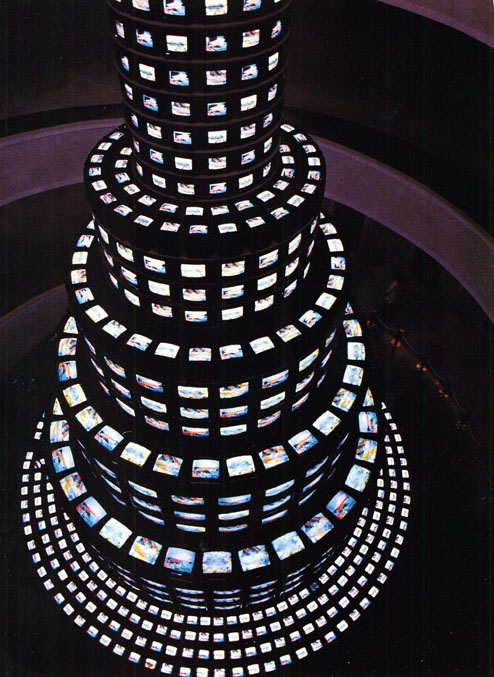
Nam June Paik's Screen Park


1. Megatron/Matrix *(1995) 
Eight channel computer driven video installation with 215 monitors, color, sound. 
Megaton: 126x270x24 inches. 
Matrix: 128x128x24

2.The More the Better, (1988) 
Three channel video installation with 1,003 monitors and steel structure; 
color, sound; 
approx. 60 ft. high.

These two pieces all formally very related. They are all made by large number of monitors and include motion and sounds to visualize a bigger picture. 

Megatron/Matrix is roughly the size of a billboard and holds 215 monitors. The mixes images are from the Korean folk rituals and some are from modern dance.In these two pieces, the artist presents his creation and ideas by two different dimensions. By the smaller clips playing simultaneously on multiple monitors, some larger animated images flow across the boundaries between screens. The timeless moment are suggesting a world without borders in the electronic age under forever-going pop culture.
Today, the fusion of pop music, commercial culture, and nationalist symbols are taking the world. Paik's video installation works just express his awareness of this overwhelming power of television.

Video has the potential to be “a new technology, experimental sphere of production, and an alternative form of television.” 

As the video works arising in the visual world, the three categories, documentary video, artistic video, and technical-aesthetic video, have expanded their context and format in different ways. The numerous potentials video art brings to this world is shaping and varying the electronic culture and the core medium, television. I think in this way, video and television are developing and arising alongside with the technical improvement and conceptual updating.

Old vs. New.
Why the olds matter?

Compared with digital camera devises, magnetic tapes and Porto Pac camera feel more “real” to me. I can see them, touch them, and that give me a feeling that the film I’m making is real too. I guess I will be more confident and believe the real tapes in hands are more save rather than the digital data in a flash drive or a computer, which can be easily ruined by a bottle of water. 

------ “TV Bra for Living Sculpture”, Nam June Paik and Charlotte Moorman.

I think this “Living Sculpture” video performance/installation is very bizarre but interesting and genius.  Charlotte was playing a cello while wearing a bra with small TV screens made by Paik over her breasts.
Bar is a very intimate thing to all female, and Paik made it into something cold and new, two TV screens. It is a very sharp example to express the intrusion of technology and humanize electronics. However, the female cello player seemed very comfortable with the TV bra and she’s performing beautiful music. That demonstrates the harmonious relationship between people and human use of technology.